Public infrastructure for
tokenised real-world assets.
Dinero is the system of record for bringing real estate, infrastructure and credit on-chain with compliance enforced at the token, personal data kept off the chain, and every action left in an audit trail regulators can inspect.
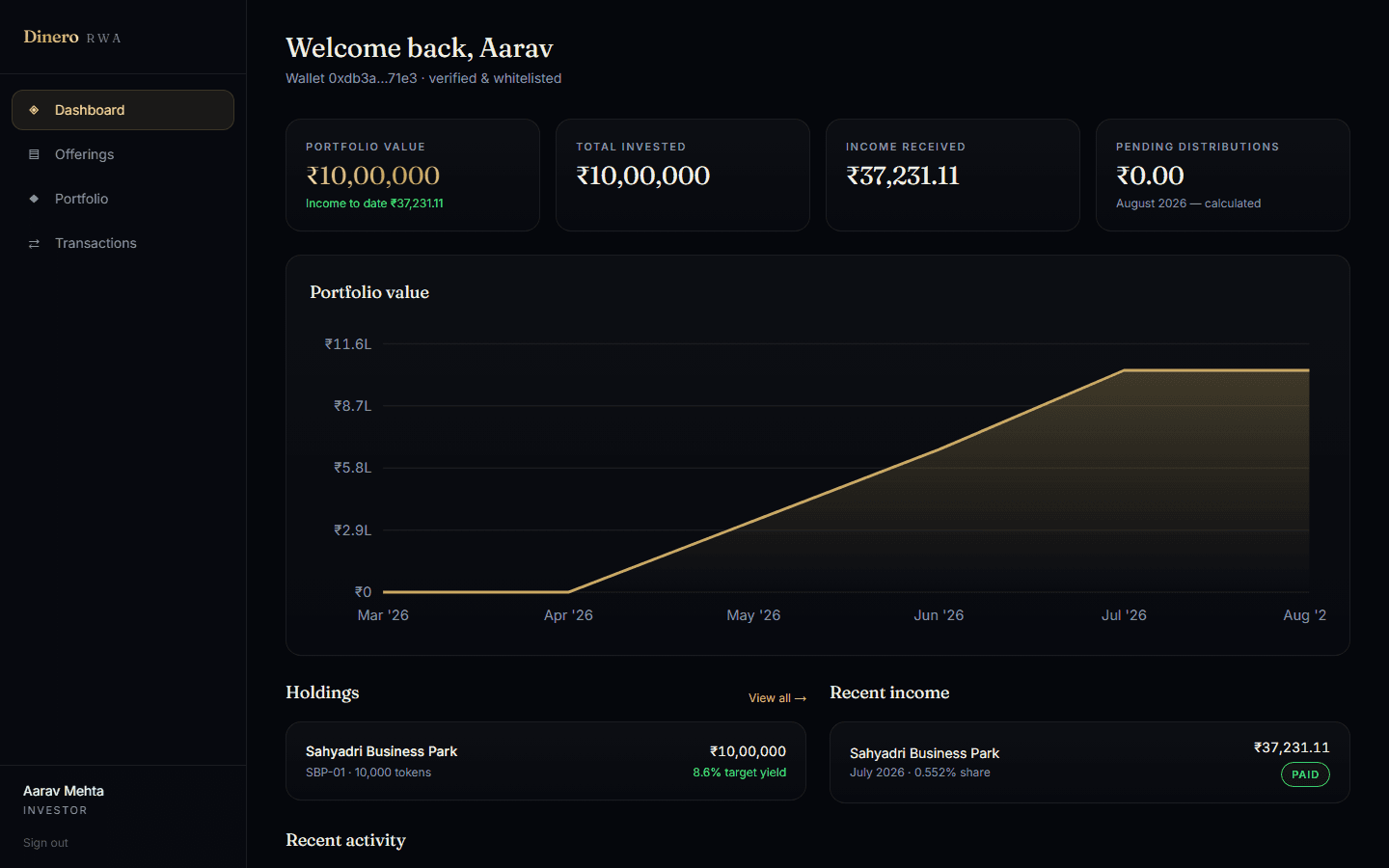
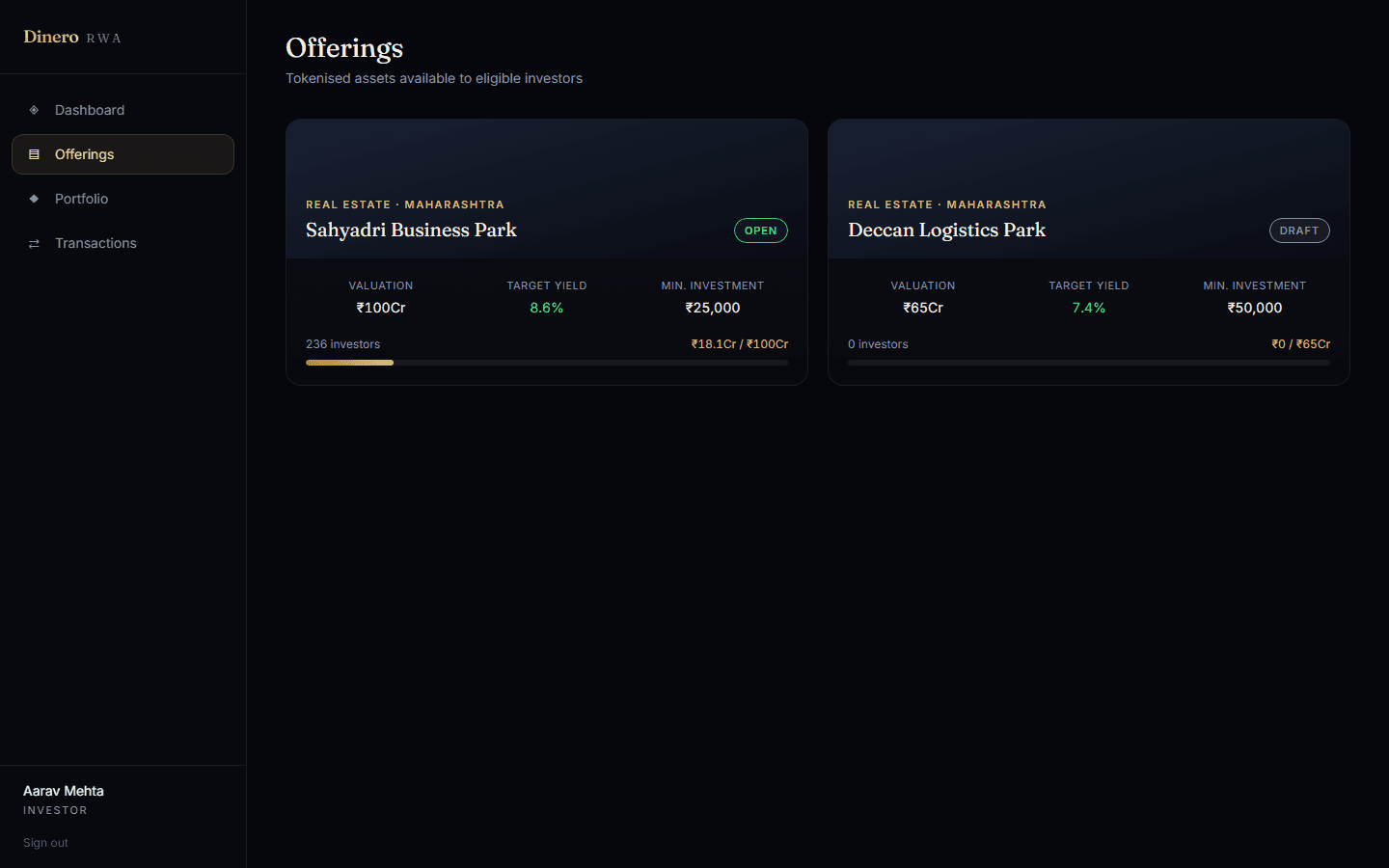
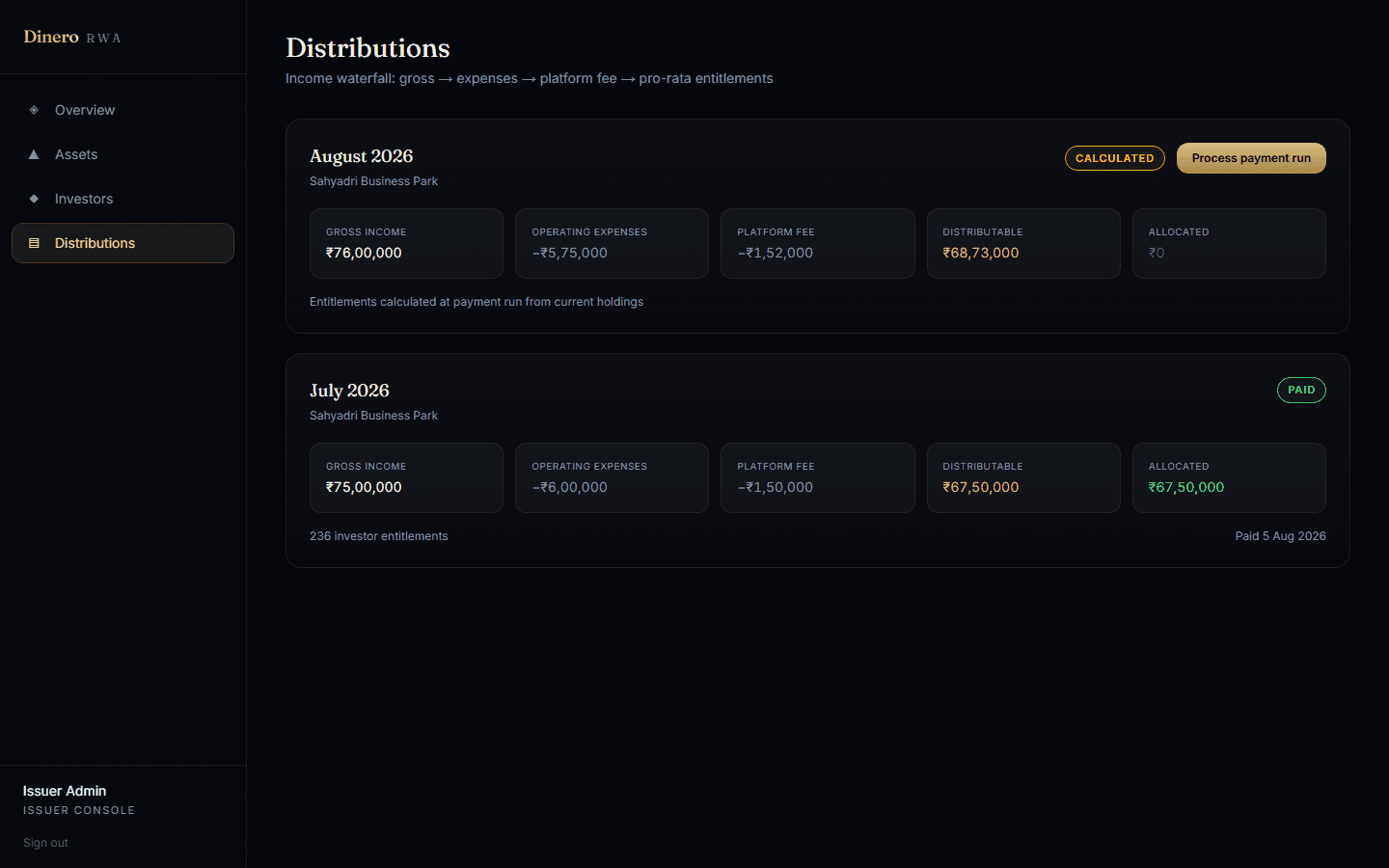
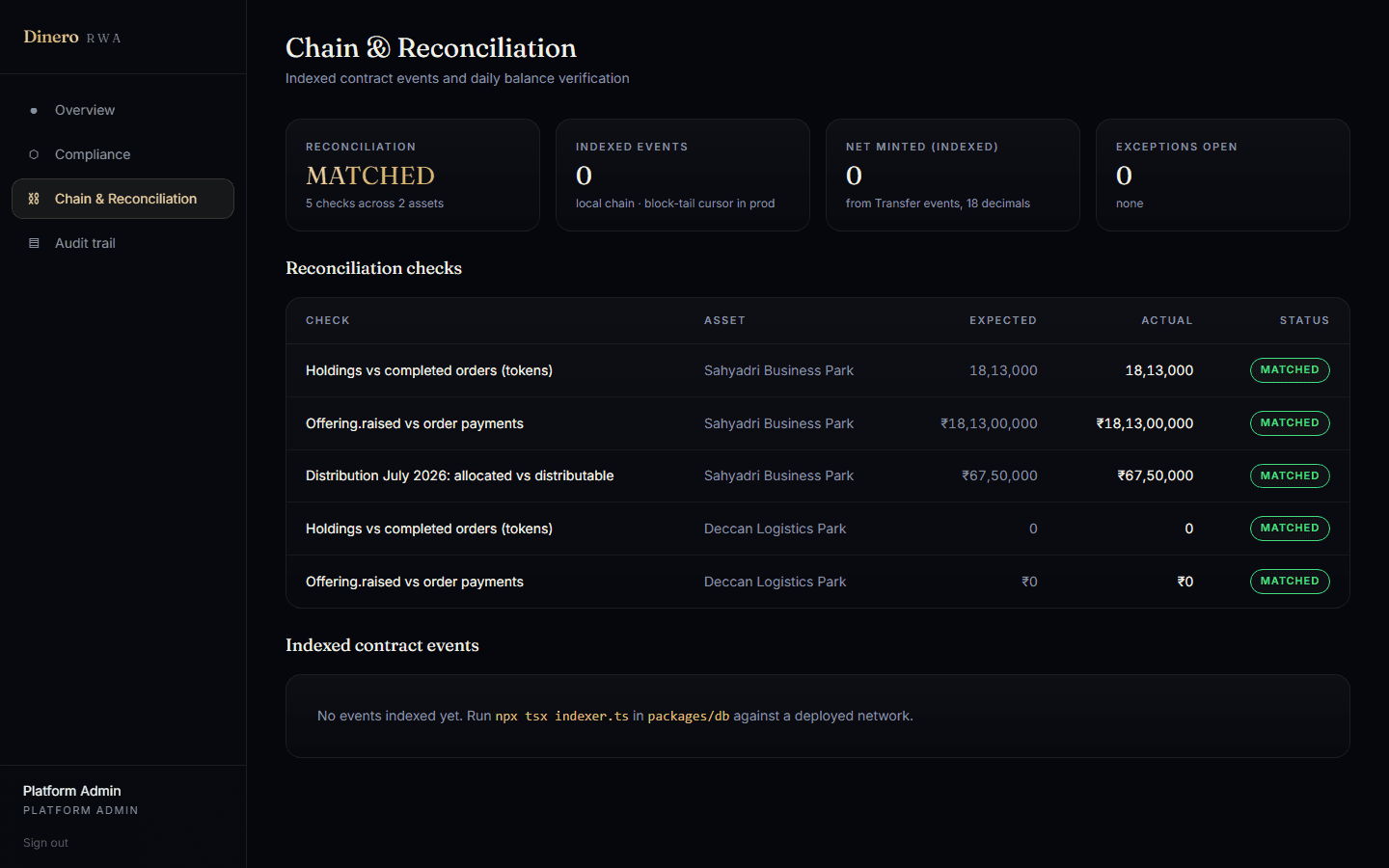
Seeded demonstration data · Dinero Capital tenant · Maharashtra portfolio
Quality assets stay locked away.
Tokenisation opens the door, safely.
India holds trillions of rupees in productive real estate, infrastructure and receivables that ordinary savers cannot reach and issuers cannot fund efficiently. The gap is not demand. It is infrastructure.
Minimum tickets in crores keep quality assets closed to ordinary savers.
Fractional units from ₹25,000 with the same legal and compliance protections.
Ownership sits in paper registers, spreadsheets and disconnected custodians.
One tamper-evident record: every holding, transfer and payout is on-chain and audited.
Distributions take weeks of reconciliation and manual bank instructions.
Income waterfall computed in minutes, statements per investor, exceptions flagged automatically.
Three portals.
One auditable record.
Every screen below is the working software, not a mock-up. Each role sees only what its mandate requires, and every action any of them takes is written to the same ledger.
A regulated on-ramp for citizens and institutions
- ✓KYC and wallet whitelisting before a single rupee can be subscribed
- ✓Offerings with valuation, target yield, lock-up and jurisdiction rules up front
- ✓Portfolio, income statements and a full transaction history in INR
- ✓Every action produces a reference number and an audit event
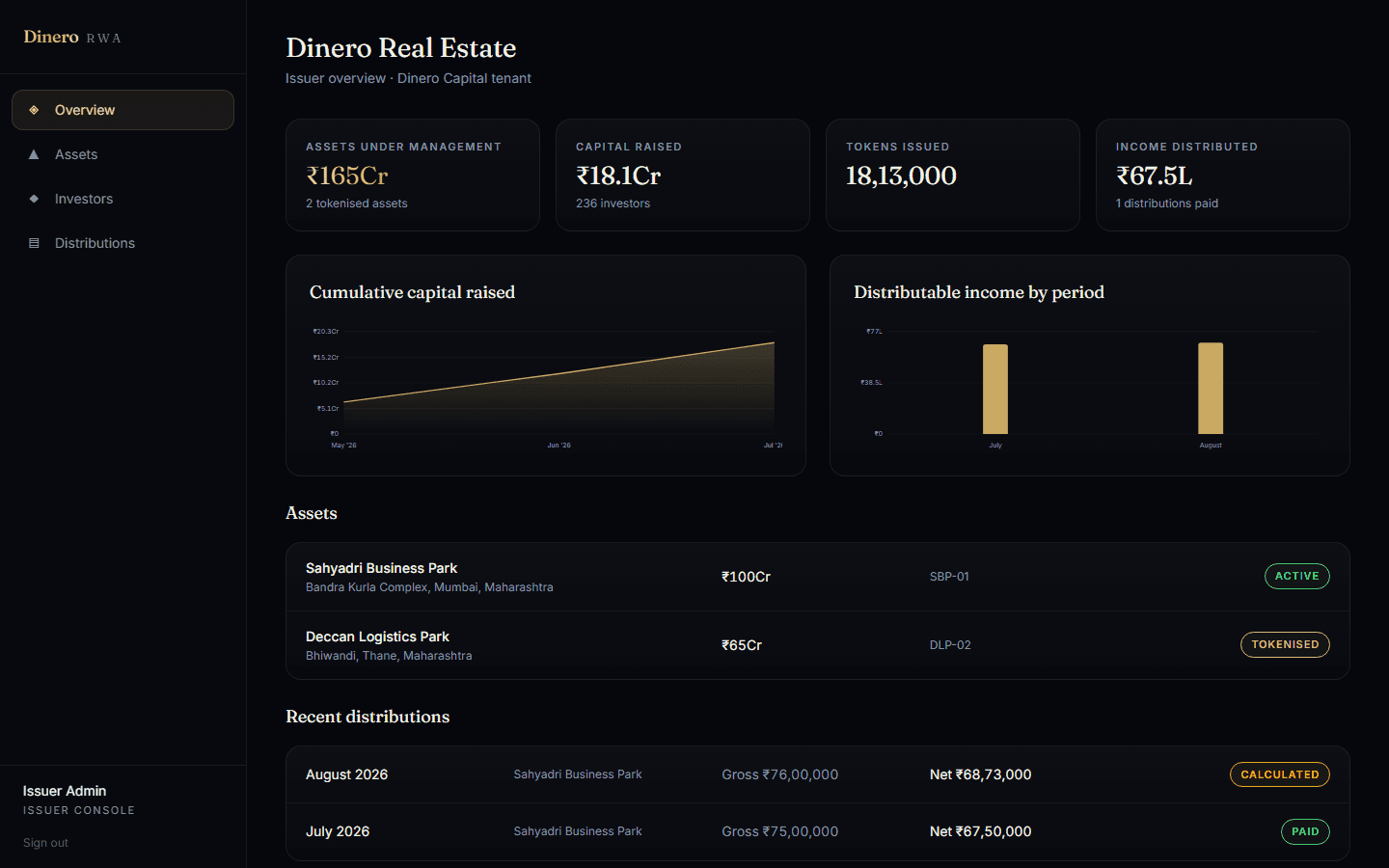
Onboard, tokenise and distribute from one desk
- ✓Asset onboarding with documents hashed and anchored, valuation history retained
- ✓Compliance-gated token deployment through the platform factory contract
- ✓Distribution runs: gross income, expenses, fees and pro-rata entitlements
- ✓Investor register with KYC state, wallet and holdings per person
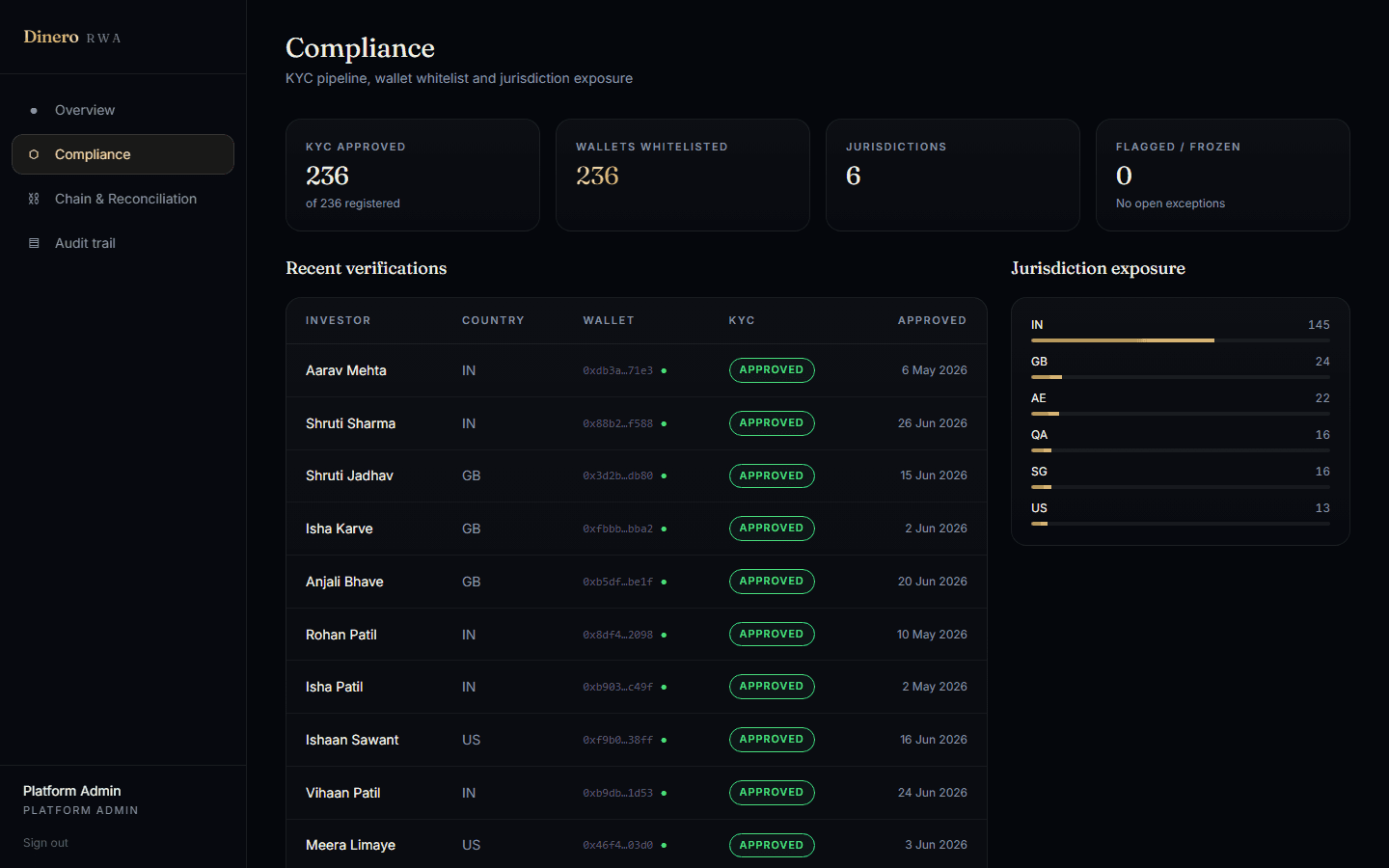
Supervision built in, not bolted on
- ✓KYC pipeline, whitelist and jurisdiction exposure at a glance
- ✓Freeze, unfreeze and forced-transfer powers for court or regulator orders
- ✓Daily database-to-chain reconciliation with open exceptions surfaced
- ✓Append-only audit trail of every critical action, exportable for inspection
Not a token launcher.
A system of record.
Eight stages from the first title document to final redemption. Each stage has a defined state, a responsible role and an audit event.
Designed to operate inside
India's regulatory perimeter.
The platform is built so that KYC, jurisdiction, lock-up and data-protection rules are enforced by code and evidenced by records, supporting the issuer's obligations under SEBI, RBI, IFSCA and DPDP frameworks as they apply to the chosen legal structure.
Eligibility enforced at the token
Mint, transfer and redemption call the on-chain ComplianceRegistry. Non-eligible wallets are rejected by the contract itself, not by a screen.
Jurisdiction and investor-type rules
Each whitelist entry carries a jurisdiction code and expiry. Offerings declare permitted jurisdictions, lock-ups and minimum and maximum tickets.
No personal data on a public chain
Names, identity documents and bank details stay in the platform database. Only wallet addresses and document hashes are written on-chain, in line with the DPDP Act, 2023.
Freeze and forced transfer
Compliance officers can freeze a wallet or move tokens under a lawful order. Both emit events that the indexer records and the audit trail retains.
Append-only audit trail
Every mutation writes an AuditLog row with actor, entity, before and after values and timestamp. Rows are never edited or deleted.
Independent reconciliation
Holdings, raised capital and distributions are re-derived from orders and chain events daily. Any mismatch opens an exception before statements go out.
The token contract consults the compliance registry inside its transfer hook. A wallet that is not whitelisted, is frozen, or whose approval has expired cannot receive or send tokens, whatever interface is used.
Conventional systems
where they belong.
A relational database remains the system of record for people, documents and money. The chain holds ownership and enforces eligibility. Each layer can be inspected, replaced or audited on its own.
Built for the assets
the state already holds.
The same lifecycle applies whether the issuer is a listed developer, a state undertaking or an urban local body. The demo tenant runs a Maharashtra commercial portfolio; the model transfers directly.
Municipal and infrastructure bonds
Fractional participation in urban infrastructure with transparent use-of-proceeds and automated coupon distribution to every holder.
Public asset monetisation
Tokenise income from government-owned commercial real estate, logistics parks and industrial estates while retaining title and control.
Warehouse receipts and agri finance
Electronic warehouse receipts as transferable, compliance-gated tokens, giving farmers and FPOs faster credit against stored produce.
Renewable energy yield
Solar and wind projects distributing power-purchase income to retail and institutional holders with per-period statements.
MSME receivables
Pooled invoice receivables issued to verified investors, shortening working-capital cycles for small enterprises.
Affordable housing
Rental income from housing stock distributed to a broad investor base, with lock-ups and jurisdiction rules enforced on-chain.
Control stays with
the institution.
Application data and audit logs reside in India-hosted PostgreSQL. The chain holds only addresses and hashes.
Issuer, agent and compliance roles are distinct on-chain roles. No single key can mint, freeze and transfer alone.
Contract admin roles move to a Safe multisig before any mainnet deployment. Single-key admin is a demo-only state.
Public Polygon for interoperability, or a private permissioned EVM network operated by the department for sovereign control.
Oversight console and exportable audit and reconciliation reports for regulators, auditors and CAG-style review.
ERC-20 with an external compliance gate and a defined upgrade path to full ERC-3643, so tokens are not locked to one vendor.
Demonstrated today.
Production-ready in three phases.
We are explicit about what is complete and what is not. Mainnet go-live is gated on an independent audit, multisig administration and a licensed KYC provider.
Working demo
- ✓Compliance-gated contracts with test suite
- ✓Investor, issuer and oversight portals
- ✓Distribution engine and reconciliation
- ✓Event indexer and audit trail
Controlled pilot
- ○Licensed KYC and AML provider integration
- ○Credential authentication and session hardening
- ○Payment gateway and escrow settlement
- ○Pilot asset with a partner issuer on testnet
Production
- ○Independent smart-contract audit
- ○Safe multisig on all admin roles
- ○Institutional API and webhooks
- ○Mainnet or permissioned network go-live
Frequently asked
What does a token represent?+
An economic interest in the underlying asset as defined by the issuer's legal structure, for example units of an SPV or a receivable pool. The platform provides the software; the issuer owns the legal wrapper and the regulatory obligation.
Is any personal data written to the blockchain?+
No. Identity documents, names and bank details never leave the platform database. The chain sees wallet addresses, token balances and SHA-256 hashes of documents.
Can a transfer be reversed or a wallet blocked?+
Yes. Compliance officers can freeze wallets and execute forced transfers under a lawful order. Both actions are on-chain functions restricted to a dedicated role and are recorded in the audit trail.
Does this require a public blockchain?+
No. The contracts run on any EVM network, including a private, permissioned chain operated by a government department. Public Polygon is used for the demo because it is inexpensive and transparent.
What is the status of the figures shown here?+
They are seeded demonstration data reflecting a ₹100 crore commercial property with 236 investors and one paid distribution. No real assets or investors are involved in the demo environment.
See the full workflow
in four minutes.
A seeded ₹100 crore commercial property, 236 investors and a live distribution run. Explore every role, or open a specific portal directly.